segunda-feira, fevereiro 12

what is "Pancake day"?

"In the UK, we have a tradition of making and eating pancakes on Shrove Tuesday, which falls between 2 February and 9 March, depending on the date for Easter. Pancake Day, or Shrove Tuesday to use its correct title, is the traditional feast day before the start of Lent on Ash Wednesday. Lent - the 40 days leading up to Easter - was traditionally a time of fasting and on Shrove Tuesday Christians went to confession and were 'shriven' (absolved from their sins). Pancake Day became a great way to use the foods that were given up for Lent – milk, butter, and eggs. The humble pancake has featured in recipe books as far back as 1439."


The popular name for Shrove Tuesday, Pancake Day marks the start of the build-up to Easter. It is followed by Ash Wednesday, the start of Lent - a Christian fast - so a custom has arisen of making pancakes to use up foods traditionally given up for Lent.

Pancake Day 2018 falls on Tuesday 13 February in 2018.
in:
https://www.mirror.co.uk/all-about/pancake-day

quinta-feira, janeiro 18

Infinitive / Gerund (explicação + avançada)
O infinitivo é a forma original do verbo tal qual se encontra num dicionário.
Pode aparecer na frase com ou sem o “to”.

O gerúndio é o verbo com a terminação –ing.

O infinitivo com “to” é de uso mais amplo aparecendo após a grande maioria dos verbos, adjetivos, advérbios, nomes, pronomes, etc:

Exemplos:
I expect to be there.
This car is hard to park.
She knows where to find the keys.

Também pode indicar propósito, finalidade:

They went there to buy something = They went there in order to buy something.

Usa-se o infinitivo sem o “to”:

1. após: modal verbs (can, could, must, etc.)
2. após: os auxiliares do-does-did-will-would
3. após: had better, would rather, rather than
4. após: as preposições but e except: exemplo: She did nothing but complain.
5. após: os verbos make e let: exemplo: You make me feel brand new.


O gerúndio é usado como substantivo nas funções de sujeito, objeto indireto ou objeto indireto (após preposição use sempre o gerúndio):
Exemplos:
1. Swimming is his favourite sport.
2. He likes swimming.


É usado também após os verbos go e come indicando atividade física, e na expressão go shopping:

We’re going riding this afternoon.
When are you going shopping? As soon as we get our salary.

Usa-se SEMPRE o gerúndio após os verbos abaixo:

Admit - Understand
Avoid - Excuse
Appreciate - Finish
Consider -  Keep
Delay - Mention
Fancy - Mind
Deny - Miss
Detest -   Practice
Dislike  - Resist
Enjoy -  Risk
Escape -  Quit

Da mesma forma com os verbos de percepção:

Feel - See
Observe -  Notice
Hear - Watch

Atente para o uso das seguintes expressões abaixo.
Algumas vêm acompanhadas de infinitivo (com ou sem o “to”), outras de gerúndio:

1. Had better (’d better): é melhor, seria melhor - sem o “to” (expressa conselho)

You’d better tell me the truth.
Had she better try again?
You’d better not leave late.

2. Would rather (’d rather): preferir

We’d rather stay home.
Would you rather watch tv?
I’d rather not see her now.

3. Used to: costumava; indica ação habitual no passado:

I used to love you.
Did he use to play tennis as a child?
They didn’t use to go to the movies.

4. Be used to/Be accustomed to/ get used to: estar acostumado a – são sempre seguidas de gerúndio porque o “to”, no caso, é preposição:
We’re used to getting up late.

5. Can’t help: não poder deixar de – sempre seguida de gerúndio:

I can’t help falling in love.

6. To be worth/worthwhile: valer a pena

It was worth listening to him.

quarta-feira, janeiro 17

Forming Gerund - breve explicação em INGLÊS + exercícios

Forming Gerunds
Here is a brief review of gerunds and how to form them.
Gerunds are nouns formed from verbs.
ex: walking, talking, thinking, listening
Gerunds are formed by adding ING to verbs.
ex: think + ing = thinking

Spelling Rules

There are a few spelling rules that you need to know in order to form gerunds correctly. The spelling of a gerund depends on the vowels (a, e, i, o, u) and consonants (b, c, d, f, etc.) at the end of the verb.


Rule


Example
If there is more than one consonant, just add INGthink + ing = thinking
If there is more than one vowel, just add INGbeat + ing = beating
If there is one vowel and one consonant, and the syllable is stressed, double the consonant and add INGhit + t + ing = hitting
If there are one or more consonants and E, remove the E and add INGtake + ing = taking
In most other cases, just add INGstudy + ing = studying
see + ing = seeing
Exercises HERE (Exercícios AQUI)

terça-feira, janeiro 16

Likes and Dislikes (GERUND)

Likes and Dislikes


Verb "to like"


Pay attention!

1. We add -s or -es in the 3rd person singular.
E.g. He likes / He doesn't like.

2. In the interrogative form we use the auxilary verb "to be" E.g. Do you like oranges? / Does he like cakes?
3. In the negative form we use the auxilary verb "to do" and the negative "not".
The verbs "likes and dislikes" can by followed by a noun.

E.g. I like apples.

They can also be followed by a verb.
For example:

When like/dislike are followed by a verb you need to add the -ing ending to the verbs.

sábado, janeiro 13

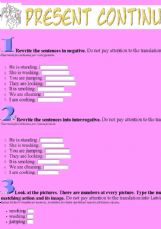
Present Continuous - some online activities

Present Continuous Activities

online cloze exercise: at the airport
Here are a few activities for you to practice the present continuous. This one here is a fill-in-the-gap exercise. Use the present simple or the present continuous.Click here to begin.


3 exercises Present Continuous3 exercises to learn Present Continuous Level: elementary
Author:Irina


PRESENT CONTINUOUSStudents complete the sentences with the PRESENT CONTINUOUS. Hope it`s useful! Level: intermediate
Author:Rosario Pacheco


The present continuous TenseThese exercises will help to practice the Present Continuous Tense. Level: elementary
Author:osat


Avril Lavigne´s Things I´ll Never SayA popular song for a short listening exercise on present continuous Level: elementary
Author:resor
Present ContinuousThis exercise will help the student to practice the present continuous. It include some exercises with (verbs+ing). Level: elementary
Author:Elizabeth Ruiz


Review -ing form some exercises to review or check if your pupils have acquire the present continuous and the -ing formation Level: elementary
Author:MariaElena

sábado, dezembro 16

Christmas Games

a reindeer on rooftops

The Santa in this game isn't real - he's a fake! Can you hit the fake Santa with a snowball? Make sure that you don't hit Rudolph the reindeer!

Game developed by Cambridge English Online


Santa
It's just before Christmas and Santa is getting fat! How can he take presents to all the children? He needs to get fit! Santa's going for a run. Can you help him run through the winter wonderland?


whose present game

Santa and Amy have a bag full of presents, but who are they for? Help Santa and Amy deliver the children's presents in time for Christmas.


Santa's been busy delivering presents and he's hidden ten toys in this puzzle. Can you find them?

Christmas printables


Do you celebrate Christmas? Print and decorate a Christmas tree, or print a page with lots of ideas for things you can make at Christmas.


Make a LearnEnglish Kids snowman! You will need scissors and glue. You could stick your snowman on a piece of folded card to make a really special Christmas card.


sexta-feira, dezembro 15

Christmas - Short Story

My Favourite Day - Christmas story

December 25th is Christmas Day. We celebrate Christmas in the United Kingdom. It's a holiday for most people, and there are lots of customs and traditions, and children get lots of presents!

Christmas - game


Interactive Game - Christmas


Revise some vocabulary related to Christmas, hobbies and talents with Santa Claus !

NOTE : This game does not work with Mozilla Firefox.


CLICA AQUI!!!

quarta-feira, dezembro 6

Present Simple - Review - 5th year


Quando deverás usar o SIMPLE PRESENT ?


Lê com atenção e tenta entender.

                            SIMPLE PRESENT emprega-se para exprimir:

1. Simples factos ou verdades aceites como tais:
    EX:  Pupils  play with computers at school.

2. Acções que persistem no tempo:
    EX:  She lives in Portugal.

3. Acções repetidas e habituais:
    EX:  get up at eight.
             She walks to school.
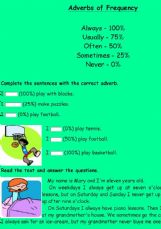
    ( Neste casos aparece ligado a certos advérbios ou expressões adverbiais .)

          Frequently    always               every day           once a week
                   usually          sometimes         every week           twice a week
         rarely              often                   every month           several times
          never                                          in the morning
             ¯                      ¯                            ¯                          ¯
      Colocam-se  entre o sujeito                              Colocam-se no final da frase
       (I / she / they / Paul /  Mary
          and John ) e o verbo.                          EX: She goes to school every morning.
     EX:  They often play football    


Vamos agora ver como se constrói o SIMPLE PRESENT:

         AFFIRMATIVE                INTERROGATIVE                   NEGATIVE
             I    eat                                   Do    I    eat ?              I  don’t    eat
          You eat                                  Do  you eat ?                     You  don’t   eat
            He                                                   he                              He
            She } eats                              Does } she  eat ?                 She  } doesn’t  eat
            It                                                      it                                It
           We eat                                   Do we eat ?                        We  don’t   eat
            You eat                                  Do  you eat ?                      You  don’t  eat
            They eat                                 Do  they eat ?                     They  don’t  eat


ATENÇÃO:
1. Nunca podes esquecer o “ S “ na 3ª pessoa do singular ( forma afirmativa )
     Nota:
               a) verbos terminados em  O , SH,  CH , SS acrescentam  “es”
                         Ex.     “goes “   catches”   “pushes”  “passes”
               
      b)  verbos terminados em “Y”
                     1. Se o “Y” vem a seguir a uma vogal, não se altera e acrescenta-se “es”
                         Ex:    “plays”  “says”  
                     2. Se o “Y” vem a seguir a uma consoante, muda para “ie “ e depois
                         acrescenta-se o “S”
                         Ex :  “ studies “    “flies”   “ tries”

2. Nunca podes esquecer que a Interrogativa se faz com a ajuda de um verbo auxiliar
    “do “ e “ does “ (esta última forma apenas para a 3º pessoa do singular- he, she, it  )

3. Nunca podes esquecer que a Negativa se faz com a ajuda de  “don’t”  e  “doesn’t”
    (esta última forma também apenas para a 3ª pessoa do singular.


®Vais mostrar a ti mesmo que sabes manipular as formas do “Simple Present”
     Preenche os espaços em branco com a forma correcta do “Simple Present”  dos verbos  que estão entre parêntesis.

1. He __________________( build ) good houses.
2. She______________________(see) the school from here.
3. They _____________________ ( always / play ) the piano in the evening.
4. How ___________________( he / like ) chocolate ?
5. She ________________________( not / speak ) to them in French.
6. I _______________( like ) my children very much.
7. She _______________( know) you quite well.
8. They ____________________ (not / live ) in Chicago.
9. Carol __________________ (study) every afternoon.
10. _____________________ (he / live) with his parents ?
11. What time _____________________ ( the boys / wake up) ?
12. We ___________________ ( sometimes / make ) mistakes.
13. _______________________( she / ever / have ) breakfast at seven ?
14. He ________________ ( fly ) to Madrid at three.
15. ____________________( you / walk) to school every day ?
16. When __________________ ( she / finish) work ?
17. Where _________________ ( they / live) ?
18. How often ______________________(he / go swimming) ?
19. She  __________________ (never / watch ) Television on weekdays.
20. My father ________________ ( enjoy) cooking.


Partilhado pela prof Rosário Barros. 
Mto Obrigada ;)